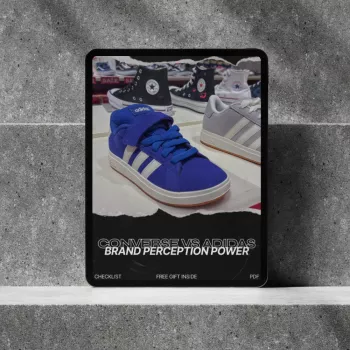
Brand perception shapes what people expect before trying a product: identity, credibility, and the social signals that come with wearing it. This checklist compares Converse and Adidas across the cues that influence trust, style status, performance assumptions, and long-term loyalty—so a decision can be made with clarity instead of hype.
Brand perception power is the quiet influence that nudges a purchase decision before a shoe ever hits the cart. It shows up in small, practical expectations that feel “obvious” even when they’re mostly learned from culture and past experience.
Converse and Adidas both benefit from “seen it everywhere” familiarity, but their heritage stories push buyers toward different assumptions.
For buyers who care about corporate context, Nike’s brand umbrella can add perceived operational confidence; for others, Converse stands alone as a distinct cultural staple. Nike’s corporate overview is available at Nike, Inc. — About.
Style status is less about “best-looking” and more about the story the shoe tells when someone sees it from across the room.
A helpful self-check: decide whether you want the shoe to be a “statement” (Adidas often reads that way) or a “baseline” that disappears into outfits (Converse often excels here).
Even before trying a model on, many shoppers “assign” comfort and capability based on brand narrative. That narrative can be useful—if it matches what you’ll actually do in the shoes.
Quality perception isn’t only about how long something lasts; it’s also about whether the purchase feels “worth it” relative to how often you’ll reach for it.
For a quick credibility pulse, compare public sustainability hubs and look for reporting depth over time. See adidas — Sustainability for program context.
| Perception factor | Converse (1–5) | Adidas (1–5) | What to look for when scoring |
|---|---|---|---|
| Style versatility | Works with most outfits, seasons, and settings without effort | ||
| Cultural identity fit | Matches personal vibe and the signals desired (subtle vs bold) | ||
| Comfort credibility | All-day wear expectations for walking/standing | ||
| Durability confidence | Material robustness, build consistency, and care needs | ||
| Performance legitimacy | Sport/training use cases and technical storytelling that feels real | ||
| Sustainability trust | Clear reporting, product-level disclosures, and verifiable claims | ||
| Value for money | Price feels fair relative to expected lifespan and frequency of wear | ||
| Availability and sizing confidence | Easy to find, consistent sizing, return experience |
For a deeper, ready-to-use version of the scoring approach, see Converse vs Adidas Brand Perception Power: The Ultimate Brand Comparison Checklist.
If you enjoy structured decision tools beyond footwear, AI-Powered Solutions for Balanced Furniture Placement | 3-in-1 Bundle of Guides, eBooks, and Checklists is another checklist-style resource built for clear, repeatable choices.
For broader context on how major brands are evaluated and compared over time, Interbrand’s methodology offers a useful reference point: Interbrand — Best Global Brands.
Converse is often perceived as more unchanged and iconic through decades, while Adidas blends timeless classics with more frequent performance and trend updates. The “timeless” pick depends on whether consistency or evolution matters more day to day.
Adidas is commonly perceived as more technical and performance-oriented, which can raise quality expectations for cushioning and materials. Converse is often judged on classic construction and styling reliability rather than technology.
Some buyers read added credibility from Nike’s scale and sport legacy, while others treat Converse as its own heritage lane regardless of ownership. The impact depends on whether corporate backing is seen as reassurance or irrelevant to style identity.






Leave a comment