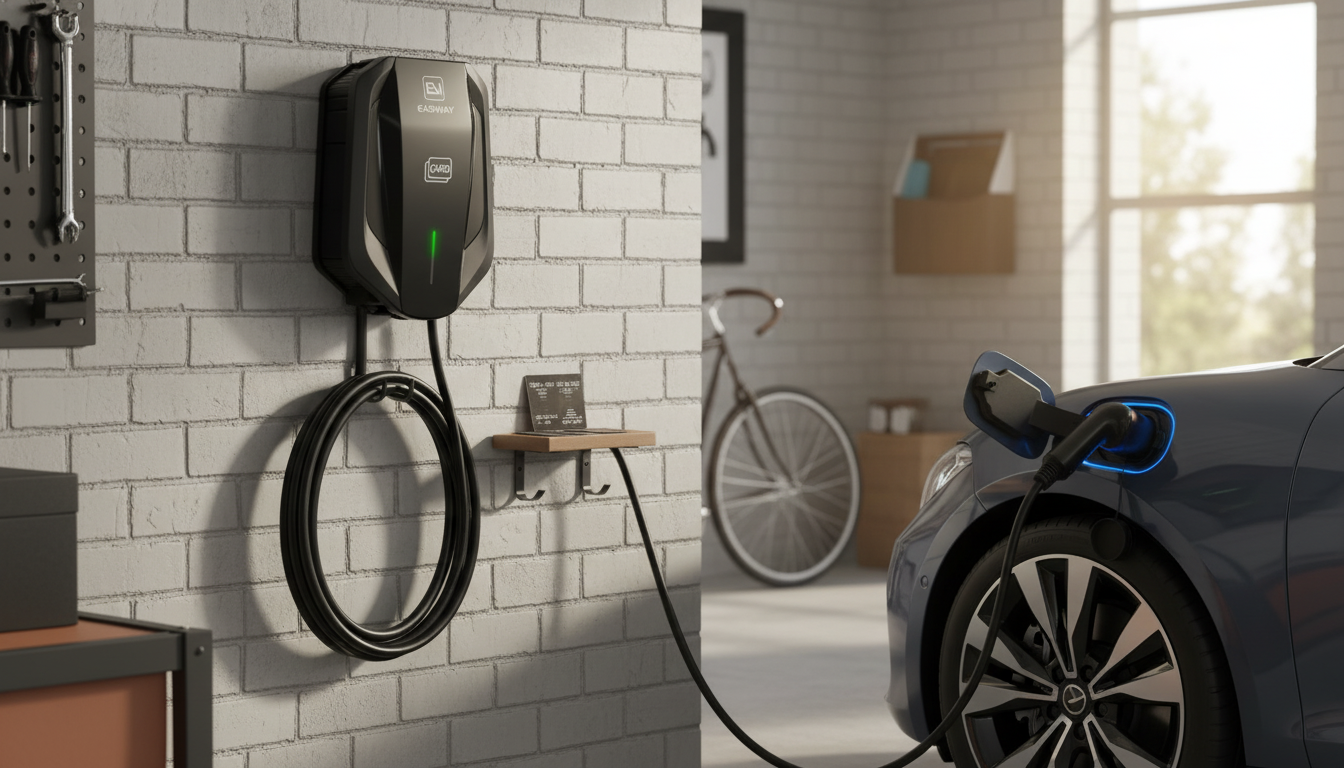
A 7kW wall-mounted charger is a practical step up from a standard socket: faster daily top-ups, a dedicated circuit, and controlled access. This guide breaks down what a 32A Type 2 charging station does best, what to confirm before installation, and how smart card activation fits shared driveways, rentals, and small fleets.
For a deeper baseline on home charging setups and what to expect from Level 2 equipment, the U.S. Department of Energy provides a helpful overview here: U.S. Department of Energy — Home Charging.
| Item | What to check | Why it matters |
|---|---|---|
| Max output | Up to 7kW (single-phase) | Faster charging than a regular plug for daily replenishment |
| Max current | 32A | Determines breaker/cable requirements and achievable charging rate |
| Connector type | Type 2 | Compatibility with most modern EVs using Type 2 inlets |
| Activation | Smart card | Prevents casual or unwanted use in shared locations |
| Mounting | Wall mounted | Neater, safer cable management and consistent parking routine |
RFID-style smart card activation is most valuable when the charger isn’t strictly “private.” Instead of relying on an app login (or leaving a charger live all the time), a card lets authorized drivers start a session instantly.
While access control is a practical feature, it doesn’t change the fundamentals of charging safety and signaling, which are governed by established EV charging standards such as IEC 61851. For background, see IEC 61851 overview and connector context from CharIN — Charging standards and connectors.
A 7kW AC station is designed for consistent, repeatable charging—think evening plug-in and a ready-to-drive battery by morning. It’s not meant to replace highway rapid charging, but it can dramatically reduce how often public charging is needed.
If the goal is reliability, the most important “speed” advantage is predictability: the same parking spot, the same cable reach, and a dedicated circuit that doesn’t compete with household loads in unsafe ways.
A 32A wall-mounted charging station is typically treated as a significant electrical load. Before purchase or installation, confirm the essentials with a qualified electrician and follow local code requirements.
It will work with EVs that can accept AC charging through a compatible inlet. Type 2 chargers match vehicles equipped with a Type 2 port (common on many models), while other vehicles may require an adapter depending on regional standards and what the vehicle supports; the car’s onboard AC charger ultimately sets the maximum AC charge rate.
Usually not—smart card (RFID) activation is commonly handled locally by the charger to start and stop charging. App features or internet connectivity depend on the specific charger model and how it’s configured.
A dedicated circuit with properly sized breaker and wiring is typical, and the installation may require an appropriate RCD/RCBO and possibly surge protection depending on local requirements. Cable sizing often needs to account for run length and voltage drop, so a qualified electrician should confirm the final design to local code.






Leave a comment